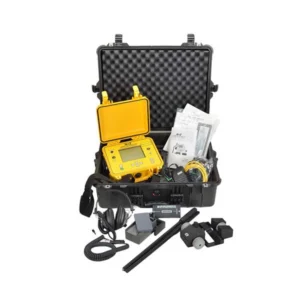
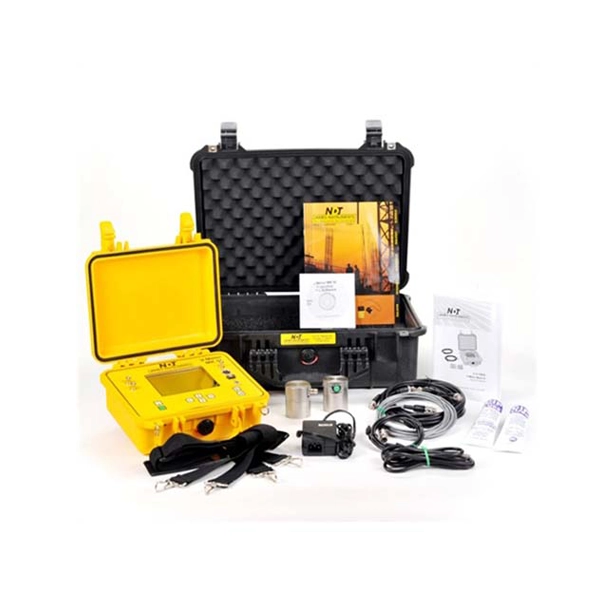
This ultrasonic testing system is designed for precise non-destructive testing (NDT) of materials with pronounced heterogeneity and coarse structure – from solid concrete and masonry to wood, ceramics and graphite. By using ultrasonic waves, the system enables reliable assessment of the material condition, detection of internal irregularities and calculation of key mechanical parameters, with repeatable results in accordance with international standards.
The device provides direct digital reading of the time-of-flight and display of the waveform on a backlit LCD display, adapted for field work. Such a display makes it easy to check the signal quality, identify attenuation and select the optimal measurement settings, especially in materials with high attenuation or inhomogeneities.
For work in construction conditions, the system is designed in a robust, splash-proof housing, while being portable and lightweight. It is powered by a rechargeable battery or standard AC power supply, making it practical for inspections on the construction site, in the laboratory or in production plants.
Advanced features include signal and trigger outputs for connection to an external oscilloscope or other data acquisition systems. The system uses digital calibration, so no special calibration strip is required, and the trigger level and signal gain are adjusted digitally – quickly and accurately, with repeatability of settings between measurements.
The system directly displays calculated P-wave and S-wave velocities, and with optional S-wave transducers it can also calculate the modulus of elasticity (Young’s modulus) and Poisson’s ratio, which is particularly useful in assessing mechanical properties and comparing zones of different quality (e.g. fire damage, degradation or segregation).
A USB case is available for computer control and advanced analysis. Via the Veelinx software, it is possible to control the system, transfer data to a computer and perform more detailed processing and analysis of measurements, which is important for documenting findings and creating reports.
A great advantage of the system is its wide support for transducers and additional equipment. Standard ultrasonic transducers are available in the range of 24 kHz to 500 kHz, covering a wide range of applications – from porous and solid concrete and wood to ceramics and graphite. For demanding conditions, exponential transducers for rough surfaces and underwater transducers are also available. In cases of long distances or materials with high attenuation, a preamplifier can be used to improve the signal quality.
The system complies with relevant standards, including ASTM C-597 and BS 1881-203, making it suitable for professional use in quality control, structural inspection and research and development tasks.
Typical applications include:
- locating honeycombs and voids in concrete
- locating cracks in concrete, ceramics, masonry or stone
- assessing the extent of fire damage in concrete or masonry
- determining crack depth
- determining Young’s modulus (with optional S-wave transducers)
- finding hidden areas of rotten wood