
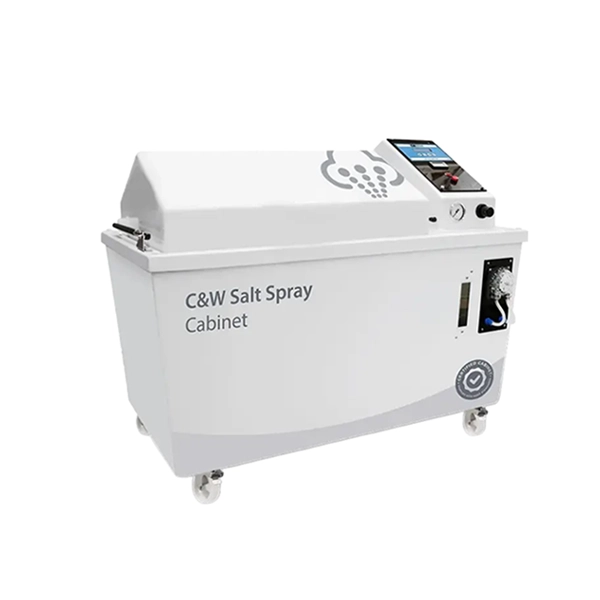
Salt spray cabinets from the specialist testing brand C&W are the proven standard in corrosion testing and precise environmental simulation. They are designed for laboratories and industrial facilities that require stable, repeatable and measurable test conditions, with reliable operation, easy handling and robust design. In practice, they are used in a wide range of industries where quality control of surface protection, coatings and materials is critical – from automotive manufacturing and paints/coatings to electronics, aerospace, defence, offshore and packaging and metal component manufacturing.
C&W cabinets enable testing to be carried out in accordance with a number of international and corporate standards (including ISO, ASTM, DIN, BS and others), facilitating the comparability of results between laboratories, suppliers and end users. The systems are developed to provide operators with easy operation, low maintenance and long service life, with construction solutions that are resistant to the aggressive salt spray environment.
Purpose and areas of application
Salt spray / salt fog testing is one of the most widely used methods for assessing the resistance of materials and surface protections to corrosion. Under controlled conditions in the chamber, an aerosol of saline solution is generated, which exposes samples to a corrosive medium in an accelerated mode. This provides insight into:
- the behavior of metal substrates (e.g. steel, aluminum) with or without protective coatings
- the effectiveness of paint systems and coatings, including multi-layer systems
- the performance of electroplating and protective treatments
- the resistance of components to long-term exposure to aggressive atmospheres
- comparison of product batches, suppliers and processes (QA/QC and development)
C&W cabinets are routinely used in the following areas:
- Aerospace: evaluation of coatings, materials and fasteners under corrosive stress
- Automotive industry: validation of coatings, floor protection, body parts and components
- Electronics: assessment of the resistance of connectors, housings and metallized parts
- Paints, inks and coatings: development and comparison of formulations, quality control of coatings
- Packaging (especially metal): verification of the behavior of materials and coatings in aggressive conditions
Offshore and industrial facilities: verification of protection for conditions of increased salinity and humidity
Military and defense industry: testing the reliability of materials and coatings in extreme conditions
Design and key features
C&W cabinets are designed for long-term operation in an aggressive salt fog atmosphere, with an emphasis on mechanical resistance, stability of conditions and practicality of operation.
Materials and robustness
The chambers are made of high-quality materials, with the key element of the housing being a specially formulated fire-resistant glass reinforced polyester (GRP). This composite material ensures very good resistance to corrosive environments, mechanical stability and reduces the risk of degradation during long test cycles.
Safety and protection
Overtemperature protection is built in, which contributes to safe operation and protects the device in the event of process deviations, operating errors or unusual operating conditions.
Ergonomics and handling
The device is equipped with an ergonomically designed control panel that makes it easier for operators to work in laboratory and industrial conditions. The emphasis is on clear process monitoring and simple parameter settings, with the aim of reducing errors and increasing repeatability.
Low maintenance
The concept of “low maintenance – high quality” is important for everyday operation. The system is designed so that critical components are accessible, and regular maintenance procedures (cleaning, checking, replacing consumables) are simple and fast, without unnecessary downtime.